
COUNTY-BY-COUNTY REPORTS:
NO. 4: CLAY COUNTY, N.C.
Petition filed to halt expansion of Shewbird Mountain mine
North Carolina grants permission to excavate up to a maximum depth of 755 feet from the crest
‘They’re going to leave my parents living on a little blade’
‘We all live in a watershed,’ middle-schoolers extol
By Tom Bennett
Special to Hiwassee River Watershed Coalition
Hayesville, N.C., Apr. 7, 2008 – Shewbird Mountain is one of the landmark features of the Earth’s natural beauty here in Clay County, where there are many of them. This is far out in western North Carolina in the Blue Ridge Mountains.
The difference with Shewbird is that since 1989, this elevation of 2,902 feet visible from two states has had a granite mine on it. The operator just received a permit to blast to a depth of 755 feet from the crest. And whether he can do this is an issue now in the North Carolina courts.
Attorney Thomas Stark of Durham filed a petition with the Office of Administrative Hearings Feb. 21. It protests the Dept. of Environment and Natural Resources’ Jan. 18 permit to Harrison Construction Co. Division of APAC, Alcoa, Tenn., to expand mining of granite by shovel and truck atop Shewbird Mountain. The Stark Law Group is asking for a September court date.
I asked Tom Stark, “So did you file a restraining order?”
“It’s automatic when you file the petition protesting the permit,” he replied.
North Carolina has a good public records law, and this citizen inspected the five-inch-thick APAC file at the DENR district office in Swannanoa, near Asheville.
A document that caught my eye was the Nov. 19, 2007 letter from James D. Simons, director of the Division of Land Resources, to Harrison Construction of Franklin, N.C.
Simons stated that a maximum depth was to have been 500 feet. However, the director continued: “Review of mine excavation profiles indicates a maximum mine depth from peak of mountain to bottom of pit would be around 755 feet and approximately 630 feet from the proposed final crest elevation to proposed bottom of pit… Please revise item A4A on page 3 of application and submit to this office.”
So the entity making the application, Harrison Construction Co. Division of APAC, Alcoa, Tenn., was not the addressed recipient of this key, helpful letter giving instruction how to fix up page 3 of the application.
MOUNTAINTOP REMOVAL MINING is a dread way of life in West Virginia. Meanwhile, a Jan. 10, 2008 memo from Judy Webner, assistant state mining specialist, to Simons shows how this industry is growing to the south, in the private lands below the Great Smoky Mountains National Park.
“There are 196 crushed stone quarries presently under permit in North Carolina and that comply with the requirements of the act (General Statutes 74-46 The Mining Act of 1971),” Webner wrote in the staff’s recommendation to Simons to go ahead with the permit.
Finally, DENR did so Jan. 18, 2008. The permit was to have been good through Sept. 2009. Mining of granite on Shewbird could expand to 297 acres, and the affected area to 86.95 acres. Here are some other stipulations:
There were to have been diversions, earthen dikes, check dams, sediment retarding structures, rip rap pits, or ditches. All blasts were to be monitored with a seismograph. The operator had to keep records of total numbers of holes; the pattern of holes and delay of intervals; the depth and size of holes; the type and total pounds of explosives; the blast location; the distance to the nearest regularly occupied structure; and the weather conditions.
THERE ARE TWO PERSONS who certainly could have been asked to assist with this monitoring of the blasts. Betty Lou and Rev. Rufus Stark live in retirement on Shewbird Lane, next door to the mine. They are the parents of Tom Stark, the Durham attorney I mentioned earlier.
The Starks served United Methodists around the state, in Leasburg, Burlington, Swepsonville, Clayton, Wilmington, Raleigh and Morehead City, and for the last 14 years of his career, Rev. Stark was president of the Methodist Children’s Home in Raleigh. First her parents, and then the Starks, enjoyed living on Lake Chatuge, and at a retreat high up on Shewbird Lane. When this family grew tired of the noise of speedboats, they moved to the high place for good and expanded it to make it their retirement home.
The noise and the shakings from the mine are serious matters. The Starks also are troubled by the harm they say is being done to tributaries of the Hiwassee River, which forms Lake Chatuge.
“There are little streams running down on both sides of our property and then down below they form Woods Creek, which runs into Lake Chatuge,” Mrs. Stark told me.
“One of the things the mining company does is to fix it so that all the water runs into their own reservoirs, where they clean the rocks, or whatever they do there, and we’re concerned that one day Woods Creek will dry up.”
Later, I talked to her son Tom Stark by phone. He is a graduate of Duke University and Duke Law School. The impact of growing up in part on Lake Chatuge and Shewbird Mountain is reflected in his being an Eagle Scout and a former chairman of the Boy Scouts of America’s Open Spaces and Trails Commission. Tom Stark said he has watched as the granite mine has steadily bought more property and expanded.
“When they first put the mine there, they promised all they were going to do was put a small pit at the bottom,” Tom Stark said. “But now what they’re trying to do is chop off the top of the mountain. They’re going to leave my parents living on a little blade.”
‘THE DEPOSITION OF SEDIMENT TO 2,800 LINEAR FEET’
You can wade in the Hiwassee River where Fires Creek flows into it and feel you have found the most serene and beautiful locale in the Blue Ridge. Then, however, you can drive a short distance to the south, minutes away along the river’s banks, and this will place you in the center of the bustling yard of Western Materials’ Mission Quarry. This gravel producer has been a polluter of the Hiwassee River, according to DENR.
The 65-acre quarry received permits in 1996 and 2001 for “continued operation of a gravel wash-water recycle system consisting of an 18,000-gallon settling lagoon and a 20-gallon-per-minute spray pump with no discharge to the surface waters.”
There is terse evidence in a June 2006 notice of violation that the quarry operators were not as careful about protecting the water as they could have been. DENR complained: “No plans have been generated in accordance with the requirements of the facility’s permit.”
In Nov. 2006, DENR’s patience was wearing thin as it wrote: “There have been unauthorized impacts to an unnamed tributary to the Hiwassee River. The sediment from the pile flows downhill approximately 75-100 feet from the toe of the slope into the unnamed tributary. The largest impacts were caused by the deposition of this sediment to approximately 2,800 linear feet of stream, and the un-permitted installation of a sediment basin in the stream.”
The file takes a hopeful turn with the June 2007 letter from Western Materials’ consultant, Soil & Environmental Consultants of Raleigh.
“A clean-up has occurred at Mission Quarry,” the consultant wrote. “All sediment was excavated by hand, and all material removed from the channel was disposed of properly. In the area where an in-line sediment basin had been installed, a channel was reformed.”
DENR has a small staff to cover the entire western tip of North Carolina, where local governments dating to the 19th Century lack zoning, erosion control, even subdivision ordinances – leaving all the environmental enforcement to DENR. I don’t know if the latter has returned to the site since that hopeful letter to prove it’s true. Meanwhile, the quarry’s permit has been renewed, according to Starr Silvis, DENR environmental engineer.
PROSPECTS FOR CLAY COUNTY AND WATER PROTECTION
Wealthy and/or credit-extended people love Clay County, its mountains, the Nantahala National Forest and Lake Chatuge. They enjoy spending part of the year here to play golf, fish, go boating or just kick back and enjoy whatever libation they’ve brought into the dry county. Meanwhile, the 9,675 full-time residents still control county government.
Herbert “Hub” Cheeks, a farmer, is chairman of the Clay commission. The other members are Stephen “Doc” Sellers and Harry Jarrett. At least two have sent signals they might support stricter rules protecting the Hiwassee River, creeks and Lake Chatuge.
“We don’t want to stop the growth, but look long-range at where we’re going to be on schools, on septic,” Hub Cheeks states in the video of the Mountain Landscapes Initiative, being facilitated this year by the Southwestern Commission of Sylva, North Carolina.
“Let’s do the best we can with the resources we’ve got,” Cheeks continues. “If we can, let’s leave them better than they were when we got them.”
Harry Jarrett is a former dean of instruction, dean of continuing education, and finally in 1992-95, president of Tri-County Community College near here. As a county commissioner, he asked neighboring Towns County, Ga., for “help with the water,” Towns Commissioner Bill Kennedy told me. Jarrett is a member of the advisory board of the Mountain Landscapes Initiative and invited its sponsors to address the Clay Co. Commission, which they did. A person by his name lives on Jarrett Road, where the county’s 300,000-gallon-per-day treatment plant is located, so has cause to think about water each day – how it’s taken out for drinking, showers and toilets, and put back into the Hiwassee River as treated effluent.
I told him there is a Mountain Landscapes Initiative effort, and the Safe Artificial Slopes Construction Act that was pigeonholed in committee in ‘07 is going to be back in the General Assembly this year.
“I am not aware of any connection between the Mountain Landscapes Initiative and the Safe Artificial Slope Act,” he said. This response reminded me how conflicted the politicians of western North Carolina are as they weigh whether to embrace environmental goals.
Paul Leek is Clay County manager. He told the “Asheville Citizen-Times” newspaper this month that he is looking forward to having the Mountain Initiative’s “tool box” for better government.
“When you are looking at doing an ordinance, you have something to start with and you don’t have to do it from scratch,” he said.
A group called Partners for an Attractive Clay County conducted a survey in January 2007 to study residents’ attitudes about natural and scenic beauty, growth and roads, according to the “Clay County Progress” newspaper.
There were 1,303 responses. The issues receiving the most responses indicating a high level of concern were clean streams, 89 percent; ridge top development, 86%; clear cutting for homes, 85%; scenic views, 85%; woodlands, 84%.; and pastures and farmlands, 74%, according to the newspaper.
THE WATERSHED COALITION’S CHALLENGE TO CLAY COUNTY
There are seven recommended actions for local governments in the Hiwassee River Watershed Coalition’s 2007 Lake Chatuge Watershed Action Plan. They are:
- establish a local sediment and erosion control program;
- evaluate your own property for potential best management practices to retain/treat stormwater;
- fund the management measures called for in the action plan;
- review and potentially revise subdivision ordinances;
- consider adopting a stormwater ordinance;
- plan for wastewater treatment for new development; and
- consider conducting a regional planning initiative.
The single additional recommendation for Clay County is to pass a mountain protection ordinance as its neighbor across the lake, Towns County, Ga., did in 2007 and then strengthened this year.
There are three National Pollutant Discharge Elemination System dischargers in Clay County, according to the 2007 Hiwassee River Basinwide Water Quality Plan. They are:
- USDA US Forest Service Jackrabbit Mountain Recreation Area;
- Clay County Water and Sewer District Hayesville Wastewater Treatment Plant; and
- Tennessee Valley Authority’s Chatuge Hydro Plant.
Finally, there are five NPDES permits pending in Clay County, according to the DENR web site. They are:
- Clay County Water and Sewer District for gravity sewer extension, pump stations and pressure sewer extensions, and a second permit for collection system management and operation;
- Rolling Frito-Lay Sales for vehicle maintenance separator stormwater discharge, which is seeking two permits for this purpose; and
- James A. and Lois R. Vanderwoude for construction stormwater.
‘LET’S HAVE A HEART AND TAKE A PART’
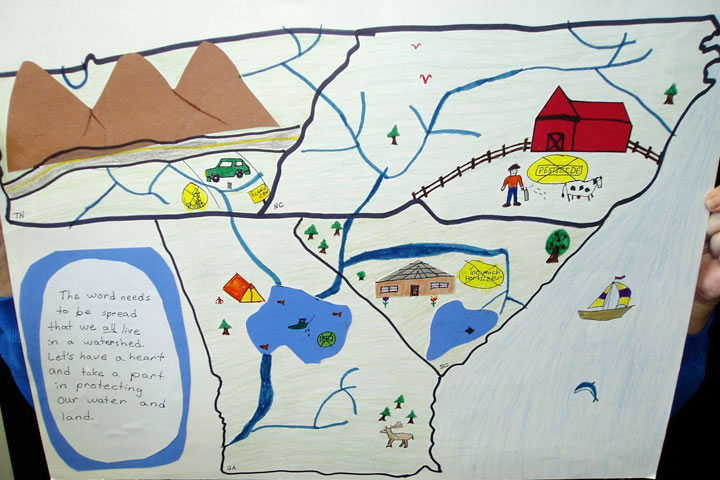 Kathryn Henrikson is in Mrs. Anita Tyson’s 4th grade class here at Hayesville Middle School. All the entries in the poster contest are impressive, in my opinion, and yet I believe hers makes the best use of this year’s theme, “We all live in a watershed.”
She has drawn with her crayons the mountains looming above and cascading their water down into the Hiwassee River and Lake Chatuge, and in a corner of her work, Kathryn Henrikson has written:
“We all live in a watershed.
Let’s have a heart
and take a part in protecting
our water and our land.”
Leanna Staton is the administrative assistant and education coordinator for Clay County Soil and Water Conservation.
I stopped by this month to visit her and her colleague, Glen Cheeks. He is the Agriculture Cost Share Program technician. Staton and Cheeks are two persons the nation has to thank for this project, heightening children’s understanding of the importance of the Blue Ridge environment.
The children will grow up in a county where there are corporations, and persons, who certainly need to hear this and as Kathryn Henrikson urged, take it to heart and have a part.
PREVIOUS COUNTY-BY-COUNTY REPORTS:
Feb. 27, 2007 – Cherokee County, NC
July 2, 2007 – Union County, GA
Aug. 31, 2007 – Towns County, GA
Tom Bennett of the Martins Creek community near Murphy, N.C., was a retired newsman, Hiwassee River Watershed Coalition member/volunteer/donor and recipient of the 2015 Holman Water Quality Stewardship Award. Tom died on December 28, 2020.